.png)
The Evolution of the Persian Language
- Hamed Parnianmehr
- Jan 12
- 6 min read
The Persian language, also known as Parsi or Farsi, is one of the oldest languages in the world, with a rich cultural and historical significance. Its roots trace back to the ancient Parsa people of Persia, who ruled the region from 550 to 330 BCE. The language belongs to the Indo-Iranian group of the Indo-European language family and has evolved through several stages over the centuries. Persian spread extensively during the reign of the Persian Empire, which reached its peak under the Achaemenid dynasty and spanned from the Indian subcontinent in the east to Egypt and the Mediterranean in the west, and from the Caspian Sea in the north to the Persian Gulf in the south.
The influence of Persian on neighboring cultures and languages is profound, and it became the language of diplomacy, science, and the arts for many centuries. Persian’s wide geographical reach and cultural importance make it a central element in understanding the history and development of Greater Iran and the broader region. Today, Persian remains the official language of Iran, Afghanistan, Tajikistan, and parts of Uzbekistan, and it is one of the most spoken languages in the world.
Historical Stages of Persian
The Persian language has undergone significant changes over time, adapting to different historical, political, and cultural circumstances. These stages can be categorized into four main periods: Old Persian, Middle Persian, Classical Persian, and Modern Persian.
1. Old Persian (circa 550 - 330 BCE)
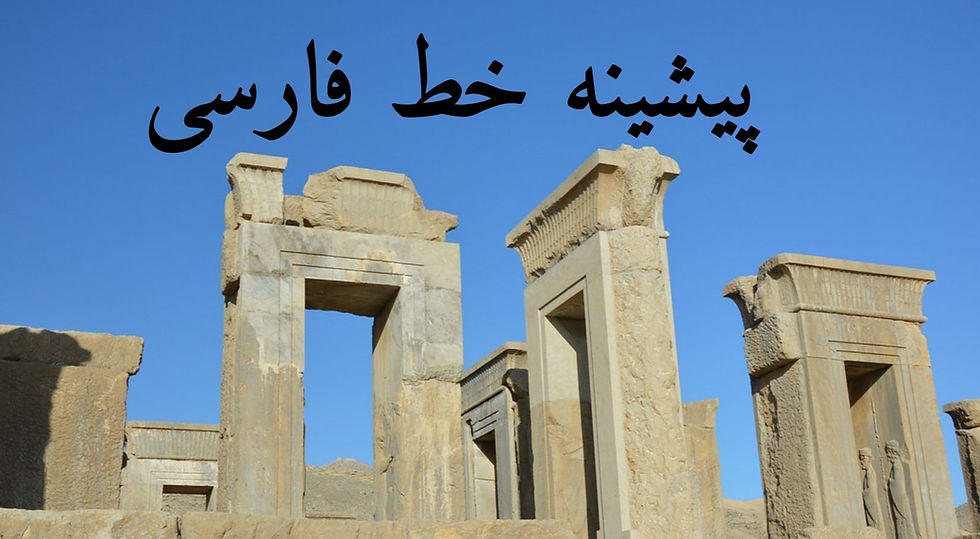
Old Persian was the language spoken by the Achaemenid Empire, the first Persian Empire, founded by Cyrus the Great. This ancient form of Persian is known primarily through inscriptions that were carved in cuneiform script, particularly on the rock faces of Persepolis, the capital of the Achaemenid Empire. The most famous of these inscriptions is the one left by King Darius I, which outlines his achievements and the expansion of the empire. These inscriptions serve as some of the earliest records of the Persian language.
The cuneiform script used during this period was quite complex, involving wedge-shaped marks made on clay tablets. This form of writing was not suited for daily communication but rather for ceremonial and monumental inscriptions. Despite being relatively short-lived, Old Persian laid the foundation for the future evolution of the language.
2. Middle Persian (circa 224 - 651 CE)
Following the fall of the Achaemenid Empire, the Sassanian Empire rose to power, and Middle Persian, also known as Pahlavi, became the dominant language during this period. Middle Persian is best known through religious, administrative, and literary texts, including Zoroastrian scriptures like the Bundahishn and the Shahnameh, as well as legal codes and historical accounts.
The Pahlavi script, derived from Aramaic, was used to write Middle Persian. While the script was somewhat more accessible than cuneiform, it was still highly stylized and complex. Despite the Sassanian Empire's strong influence, the Arabs’ conquest of Persia in the 7th century introduced a new phase of linguistic change, with Arabic gradually overtaking Persian as the language of religion, science, and administration.
3. Classical Persian (circa 9th - 15th centuries)
Classical Persian, which emerged after the Arab conquest, represents the culmination of Persian’s evolution into a sophisticated literary and cultural language. It was during this period that Persian poets like Ferdowsi, Rumi, Omar Khayyam, and Hafez produced some of the most important works in world literature.
Ferdowsi's Shahnameh, an epic poem that recounts the history of Persia from its mythological beginnings to the Arab invasion, is considered one of the crowning achievements of Persian literature. Ferdowsi's work was particularly significant in preserving the Persian language and culture during a time when Arabic was dominant due to the Islamic influence.
This period also saw the integration of Arabic vocabulary into Persian, especially in technical and religious terms, as Arabic became the language of scholarship and religion. While the language borrowed heavily from Arabic, Persian poets and scholars worked to maintain its distinct identity and continue using pre-Islamic Persian roots.
4. Modern Persian (16th century - present)
Modern Persian, or Farsi, is the form of the language spoken today. It retains many features from its classical roots but has evolved to incorporate modern influences, including the integration of foreign words, primarily from Arabic, French, English, and other European languages.
The adoption of the Arabic script to write Persian during the Islamic period marked a significant turning point in the development of the language. While Persian sounds that did not exist in Arabic were accommodated by adding extra characters, the Arabic script is still a source of linguistic challenges for Persian speakers today. In addition to its Arabic influences, Persian has also borrowed words from European languages, especially in the realms of science, technology, and modern culture.
Despite the continued incorporation of foreign terms, there has been a concerted effort by the Iranian government and language purists to revive Persian's native vocabulary. For example, the introduction of words like khodro (car) and shabakeh (network) replace imported words like automobile and internet, demonstrating the flexibility and adaptability of Persian in the modern age.
Regional Variants of Persian
While Persian is the official language of Iran, Afghanistan, and Tajikistan, each region has developed its own variant of the language, with some notable differences in vocabulary, pronunciation, and even script.
Dari: In Afghanistan, Persian is known as Dari. Although it shares much of its structure with the Persian spoken in Iran, Dari preserves some archaic forms of the language and is considered by some to be closer to Classical Persian. In addition, Dari has its own literary tradition, with poets such as Saadi and Khayyam influencing Afghan culture as well.
Tajik Persian: In Tajikistan, Persian is known as Tajik. Due to the influence of the Soviet Union, Tajik Persian is written using the Cyrillic script, in contrast to the Arabic script used in Iran and Afghanistan. Tajik Persian has preserved more of its pre-Islamic linguistic features and has been somewhat less influenced by Arabic, making it a purer form of the language in some respects.
Zoroastrian Dari: Among the Zoroastrian communities in Iran, there exists a variant of Dari that has been passed down orally for centuries. This version of Dari, spoken in areas like Yazd and Kerman, has no written script and is unique to these communities. It remains largely a spoken language, with younger generations being less familiar with it due to the lack of formal education in the language.
Arabic Influence and Linguistic Borrowing
The Arab conquest of Persia in the 7th century had a profound impact on the Persian language. Arabic became the dominant language for religion, governance, and scholarship, leading to the widespread adoption of Arabic vocabulary in Persian. This influence is most notable in religious and technical terms, where Persian adopted Arabic words for concepts related to Islam, governance, and science.
In addition to Arabic, Persian has absorbed vocabulary from various languages due to historical contact, including Turkish, French, and English. However, the incorporation of foreign terms has been met with resistance from language purists, who advocate for the revival of indigenous Persian words. This tension between modernization and tradition continues to shape the development of the Persian language in the contemporary world.
Persian in the Modern World
Today, Persian is spoken by over 100 million people, making it one of the most widely spoken languages globally. It remains an important language in the cultural, academic, and political spheres of Iran, Afghanistan, and Tajikistan. Persian literature, including the works of poets like Hafez, Rumi, and Saadi, continues to be studied and celebrated worldwide for its philosophical depth, emotional resonance, and aesthetic beauty.
In the age of globalization, Persian faces challenges as it adapts to the digital world and interacts with new linguistic influences. The proliferation of the internet and social media has introduced new vocabulary, some of which is borrowed from English, while others are uniquely Persian coinages. The ability of the Persian language to remain relevant and dynamic in a rapidly changing world is a testament to its resilience and the enduring cultural strength of its speakers.
Conclusion
The Persian language has a rich and complex history that reflects the cultural, political, and social changes of the Iranian people over millennia. From its ancient origins in the Achaemenid Empire to its modern form spoken today, Persian has evolved through various stages, adapting to new influences while preserving its core identity. The language has been shaped by the rise and fall of empires, the spread of Islam, and the ongoing pressures of globalization.
Persian’s cultural significance goes far beyond its role as a means of communication. It is a symbol of Persian identity, a repository of the region’s literary and philosophical heritage, and a living testament to the resilience of its people. As Persian continues to adapt to the modern world, it remains a vital and dynamic language that bridges the past and the future, offering a window into the heart of Iran’s rich cultural legacy.
Comments